
Possible environmental concerns arose regarding the Columbia River, as a light oil sheen can be seen floating on the river’s surface.
Read the complete article here.
Read the entire article here.

In a petition for rulemaking, Schneiderman asked the agency to require all crude transported by rail in the United States to achieve a vapor pressure of less than 9 pounds per square inch (psi).
Read more from Progressive Railroading.

The trend emerged in the past six months and marks a shift in a years-long boom in transporting crude-by-rail after rail companies, such as Greenbrier and GATX, rushed to increase tank car capacity as the U.S. shale revolution took off five years ago.
Read more from Business News Network.

About 3,000 firefighters and other emergency responders from 80 departments throughout the state have been trained to respond quickly to oil-train-related disasters, and the Minnesota Pollution Control Agency has increased scrutiny of the accident response plans prepared by railroads and emergency personnel.
On the national level, the Federal Railroad Administration permanently extended a requirement for railroads transporting highly explosive oil, such as the crude being shipped from the Bakken region of North Dakota, to disclose the expected movement of their trains. The extension came after prodding from Sen. Al Franken and others.
Read more from Post Bulletin.

The inspections are part of the governor’s efforts to address the safety of crude-by-rail shipments. State and federal teams examined 524 tank cars and about 152 miles of track and 38 switches during the inspections.
Last week, inspection teams from the New York State Department of Transportation (NYSDOT) and Federal Railroad Administration (FRA) inspected tank cars at Canadian Pacific’s Kenwood Yard in Albany, CSX Transportation’s Selkirk Yard in Albany County and Frontier Yard in Buffalo, and the Buffalo & Pittsburgh Railroad’s D&E Yard in Buffalo. They also inspected various CP and CSX mainlines.
Read more from Progressive Railroading.

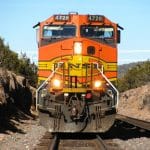
Fort Worth-based BNSF Railway, the largest U.S. crude-by-rail carrier, is offering lower rates to lug oil in cars that meet the latest federal specifications issued in May. That means the vast majority of cars riding the rails today, known as DOT-111 and CPC-1232, will cost more to haul.
The new rates are part of a plan by the railroad, owned by Warren Buffett’s Berkshire Hathaway, to push older cars off the tracks as regulators scrutinize the industry over a series of high-profile derailments and explosions. To that end, BNSF published higher rates for older cars relative to more advanced models, such as the DOT-117, said spokesman Michael Trevino.
Read more from Star-Telegram.

“There is not a whole lot we can do to regulate rails going through our area because they are primarily regulated by the federal government, and I use the word regulated in quotes sometimes,” said state Sen. Loretta Weinberg (D-Bergen). “The federal government has predicted that we will see… explosions and disasters with increasing frequency as more oil is shipped to refineries.”
The state Senate’s Transportation Committee approved three measures on the issue.
Read more from NJ.com.

Investigators from the National Transportation Safety Board (NTSB) and Federal Railroad Administration (FRA) are on the scene today of a BNSF Railway Co. crude-oil train that derailed and caught fire yesterday morning in Heimdal, N.D.
The BNSF train consisted of 109 total cars, 107 of which were loaded with crude oil. Two buffer cars were loaded with sand. Six of the crude oil cars derailed at about 7:30 a.m., resulting in a fire and the town’s evacuation. All other cars were pulled away from the scene to a safe distance. No injuries were reported, according to a statement issued by BNSF.
The tank cars involved in the incident were the unjacketed CPC-1232 models, which are among the tank-car models slated for retrofits or phasing out under new federal rules governing the safety of crude-by-rail transportation.
Read more from Progressive Railroading.
A train carrying crude oil through Wells County, North Dakota derailed May 6. At least six rail cars have caught fire, sending thick, black plumes of smoke billowing into the sky. The village of Heimdal and nearby farms were evacuated.
The BNSF Railway oil tanker derailed around 7:30 a.m. local time, Wells County Emergency Manager Tammy Roehrich said, the Grand Forks Herald reported.
Emergency crews from several fire departments across the region responded, as well as hazardous materials teams from Devils Lakes and Grand Forks, Cecily Fong, public information officer for the North Dakota Department of Emergency Services, said.
Read more from RT.